admin
admin
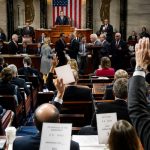
The House of Representatives voted this week to pass a war‑powers resolution aimed at pushing President Trump to pull U.S. forces back from hostilities with Iran. The measure, H.Con.Res.89, squeaked through 214–208 and is largely a congressional rebuke — more theater than law. Still, the vote tells a story about where a handful of Republicans stand when it comes to supporting the commander‑in‑chief and protecting American forces.
What H.Con.Res.89 actually does
Representative Pramila Jayapal sponsored the concurrent war‑powers resolution, which tells the President to remove U.S. Armed Forces from hostilities with Iran under the War Powers Resolution. The roll call read 214 yeas to 208 nays. Because this is a concurrent resolution under Section 5(c) of the War Powers Resolution, it has no force of law and does not require the President’s signature. In plain terms: it’s a political statement, not a legal order.
The four Republicans who broke ranks
Four House Republicans joined Democrats to vote yea: Representative Thomas Massie (R‑Ky.), Representative Warren Davidson (R‑Ohio), Representative Tom Barrett (R‑Mich.), and Representative Brian Fitzpatrick (R‑Pa.). They repeated the same split as in an earlier vote this year. Fitzpatrick defended his choice by citing the War Powers Act’s 60‑day rule and a need to “follow the law.” Fair enough — unless following that law hands our generals less room to keep Americans safe while Congress grandstands.
Why this vote matters — and why it won’t change policy
The resolution’s power is political. It sends a public message and puts pressure on the White House. But it doesn’t bind President Trump, and it won’t change operations on the ground. The Senate is expected to reject the measure, and many Republicans in both chambers rightly point out the Constitution vests war powers — including the authority to defend the nation — in the executive during crises. So the real battlefield won’t be the House floor; it will be in public opinion, media narratives, and future funding fights.
Congress should be focused on supporting the troops and on clear, sober oversight — not on theatrical votes that make headlines and do nothing to protect Americans. If four Republicans wanted to show principle, they could demand real debate and a clear alternative plan instead of joining Democrats for symbolic theater. Short of that, this episode is a reminder: when it comes to national security, talk is cheap and cohesion matters. Here’s hoping lawmakers stop the virtue signaling and start doing the hard work of keeping America safe — before the next crisis arrives and there’s no time left for a vote.